
Order discount
An order discount takes a percentage or a fixed amount off the whole order — with an optional cap on the discount, a cart value limit, items you exclude from the calculation, and a minimum order amount measured after product discounts.
-
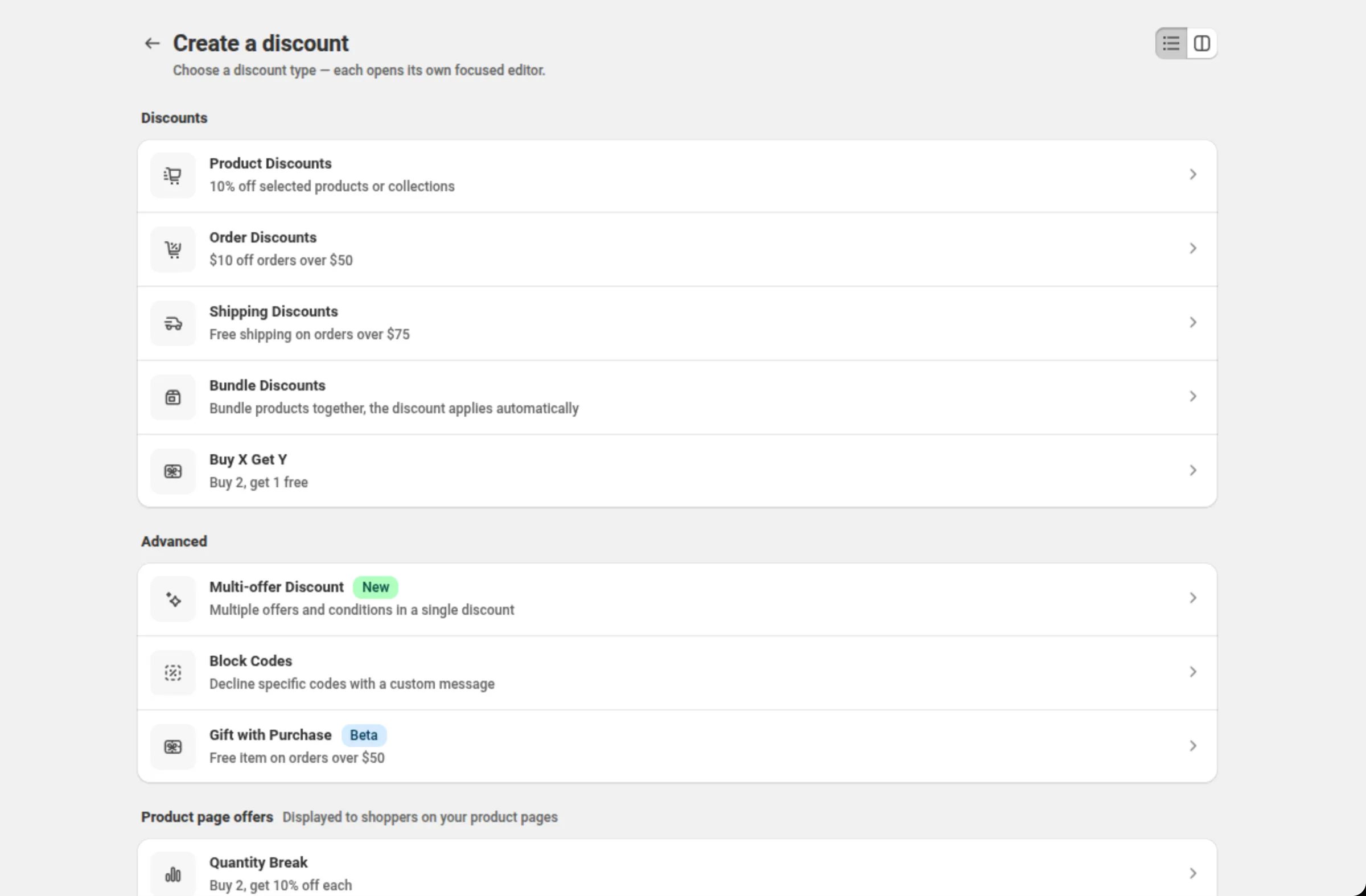
Open Discounts and click Create discount, then choose Order Discounts.
The create menu lists Order Discounts under Discounts, with the example “$10 off orders over $50”.
-
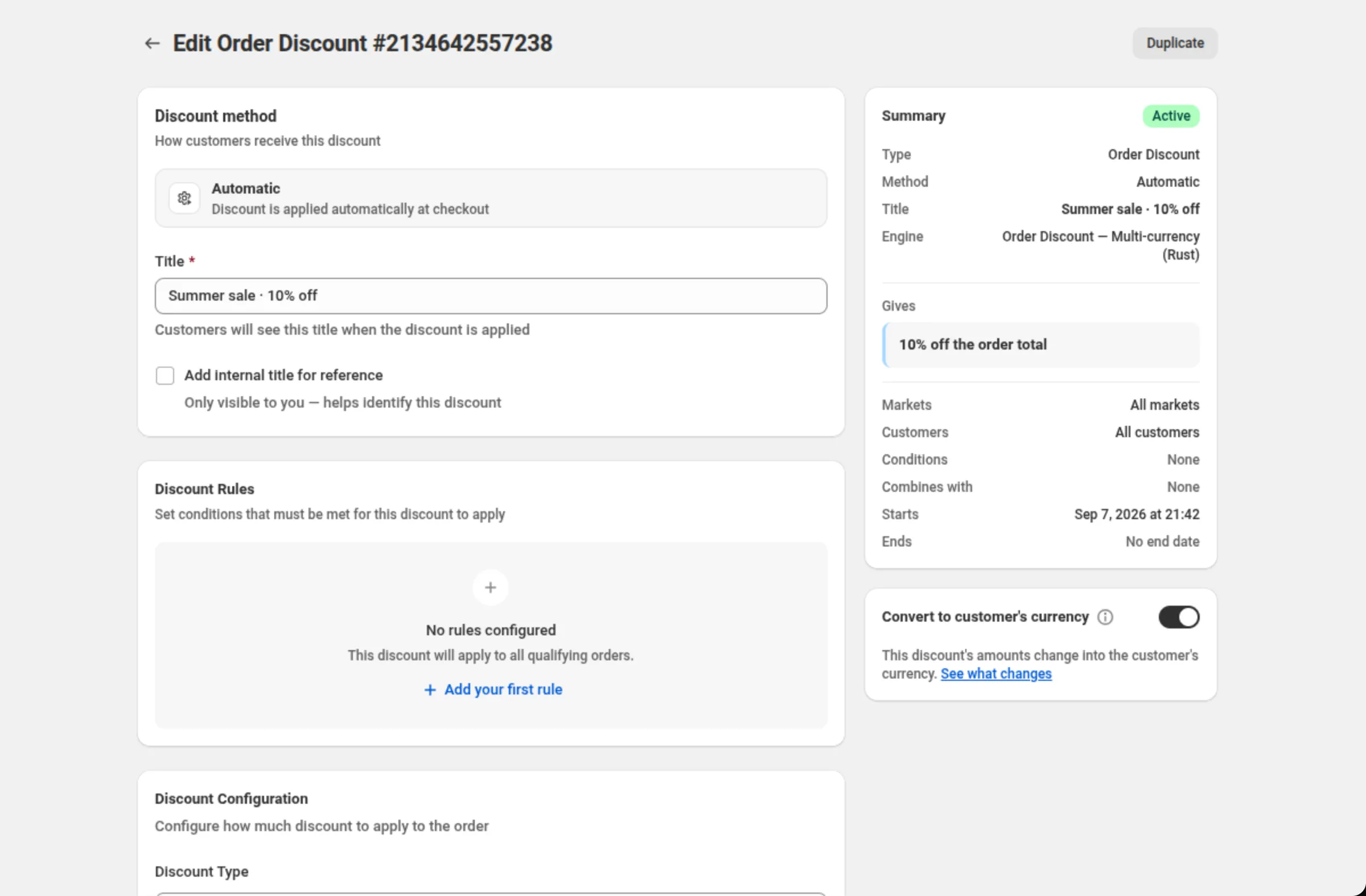
Choose the discount method and name the discount.
Pick Automatic or Discount Code, then fill in Title (automatic) or Discount Code (code). The summary on the right keeps a running recap of what you have set so far.
-
Add discount rules for when the discount should apply.
Click Add your first rule to create RULE GROUP #1, then pick a condition, an operator and a value — for example Cart subtotal · is greater than or equal to · 50. Use Add condition for more conditions in the same group and Add rule group for another group. With no rules at all, the discount applies to all qualifying orders.
-
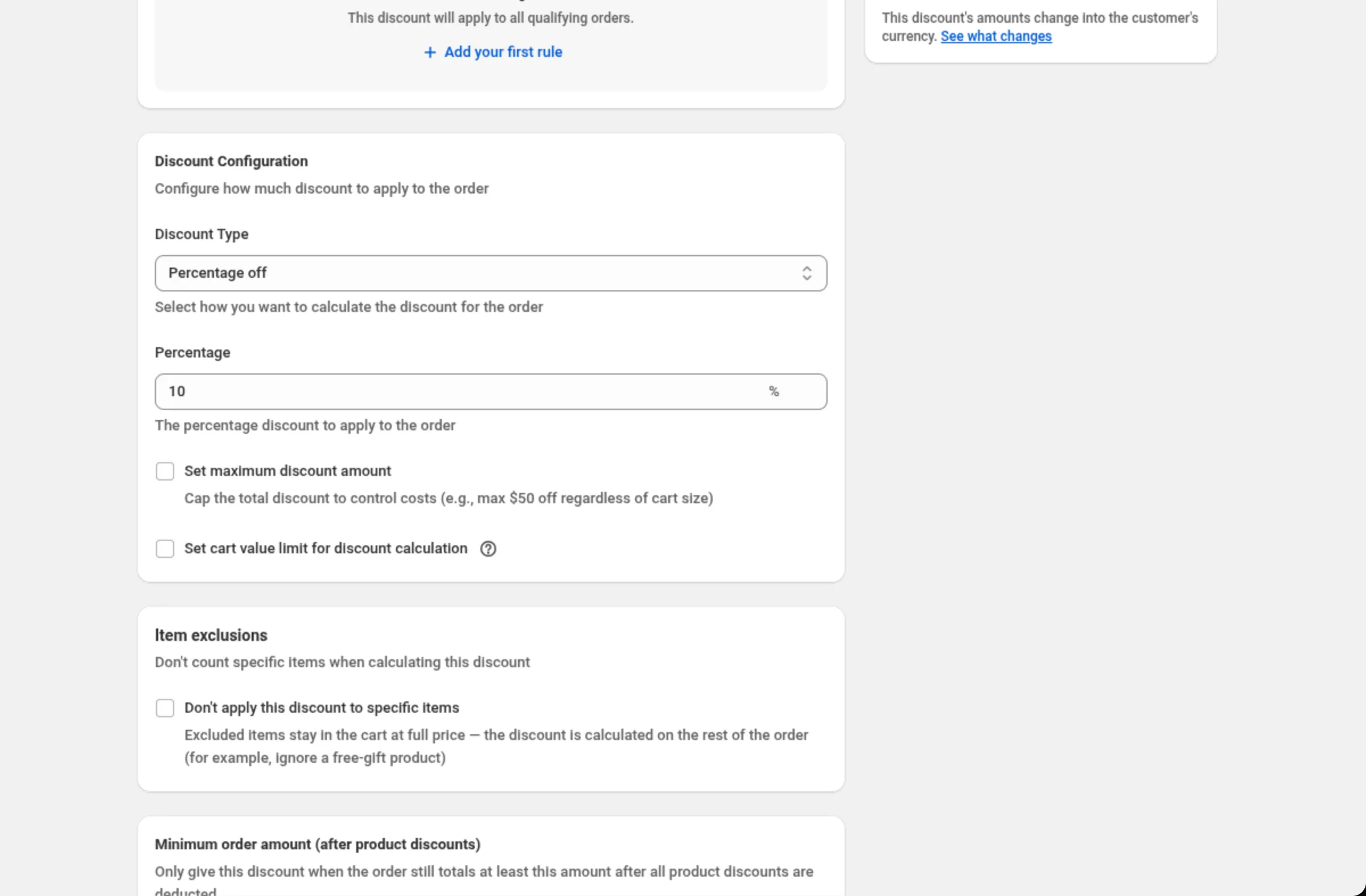
Choose the discount type and enter the amount.
Set Discount Type to Percentage off or Fixed amount off, then enter the value. For a percentage you can also tick Set maximum discount amount and Set cart value limit for discount calculation.
-
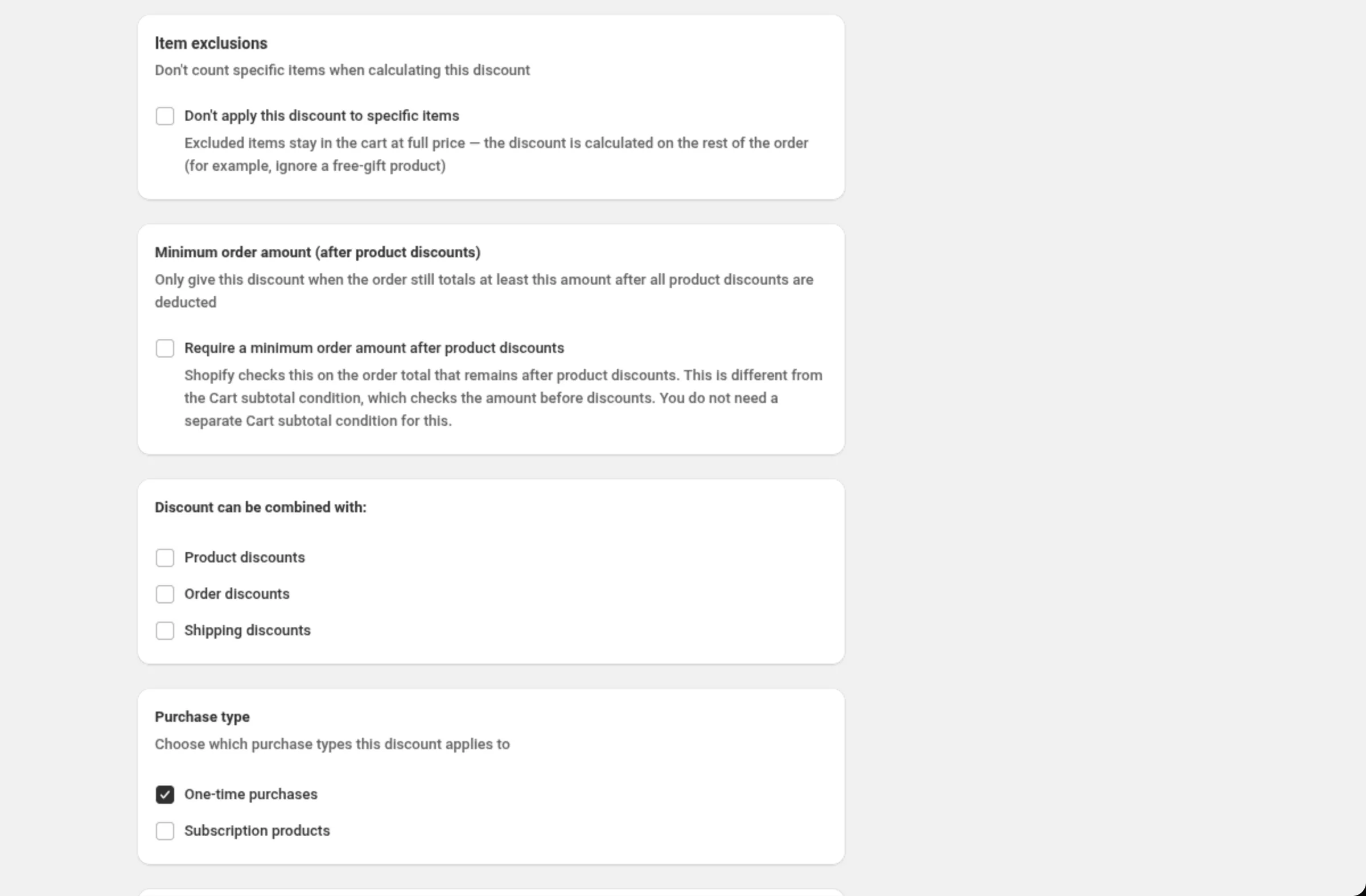
Set item exclusions and the minimum order amount after product discounts.
Tick Don’t apply this discount to specific items to keep chosen products or collections out of the calculation, and Require a minimum order amount after product discounts to ask for a floor Shopify measures once product discounts are deducted. Both are optional.
-
Set combinations, customers, markets and dates, then save.
Choose which other discounts this one may combine with, whether to limit it to customer segments, which markets it runs in, and when it starts and ends. Save from the bar at the top of the page.
Settings
Section titled “Settings”Discount method
Section titled “Discount method”Automatic needs no code — Shopify applies the discount as soon as an order matches. Discount Code means the shopper has to enter the code you set. Choose the method when you create the discount: the chooser is disabled once the discount exists.
Title / Discount Code
Section titled “Title / Discount Code”On an automatic discount, Title is the name shoppers see when the discount is applied. On a code discount the field becomes Discount Code, and it accepts only letters, numbers, underscores and hyphens.
Add internal title for reference
Section titled “Add internal title for reference”Adds a second name that is only visible to you, to tell similar discounts apart. Use it when the customer-facing title is not specific enough for your own list.
Discount Rules
Section titled “Discount Rules”The conditions an order must meet. An order discount can use Cart subtotal, Cart quantity, Cart attribute, Customer tags, Customer logged in, Customer is B2B, Customer orders count, Specific products, Specific variants, Specific collections, Product tags, Line quantity, Line subtotal, Line attribute and Has selling plan. Conditions inside a group join with the Between conditions AND/OR toggle; groups join with Match All Rule Groups or Match Any Rule Group.
Discount Type
Section titled “Discount Type”Percentage off takes a share of the order total; Fixed amount off takes a set amount off it. Changing the type clears the values you had entered for the previous one.
Percentage
Section titled “Percentage”The share taken off the order total. It must be greater than 0 and no more than 100 — the field and the server both refuse anything outside that.
Set maximum discount amount
Section titled “Set maximum discount amount”Caps the total discount in money, whatever the order is worth: a 20% discount with a maximum of 50 never gives more than 50 off. Use it to keep a percentage discount predictable on large orders.
Set cart value limit for discount calculation
Section titled “Set cart value limit for discount calculation”Applies the percentage only up to the cart value you enter. With a limit of 500 and 10% off, an 800 cart is discounted 50 (10% of 500) and a 300 cart is discounted 30.
Discount Amount
Section titled “Discount Amount”The fixed amount taken off the order total, entered in your store’s currency. It must be greater than 0.
Set exact amounts for specific currencies
Section titled “Set exact amounts for specific currencies”Only shown on discounts that convert currency. Lets you type the exact amount customers paying in a listed currency get — useful when a converted amount lands on an awkward number, like ¥1,655 in a store priced in multiples of ¥100. Up to 20 currencies; every other currency uses the amount above, and if you leave that blank only the listed currencies get the discount.
Item exclusions
Section titled “Item exclusions”Don’t apply this discount to specific items keeps chosen products and collections out of the calculation — they stay in the cart at full price. Up to 20 products and 10 collections. The choice below it decides whether those items still count toward your minimums: Count excluded items toward requirements (the default) or Ignore excluded items everywhere.
Minimum order amount (after product discounts)
Section titled “Minimum order amount (after product discounts)”Requires the order to still total at least the amount you enter once all product discounts are deducted. Shopify checks this on the remaining total, which is what makes it different from a Cart subtotal condition. It cannot be combined with a maximum discount amount or a cart value limit.
Discount can be combined with:
Section titled “Discount can be combined with:”Ticks for Product discounts, Order discounts and Shipping discounts. Leave them off and this discount runs alone; tick a box and Shopify may apply that kind of discount alongside it.
Maximum discount usage
Section titled “Maximum discount usage”Only shown for a discount code. Limit number of times this discount can be used in total adds a Maximum discount uses field (a whole number greater than 0), and Limit to one use per customer caps it per shopper.
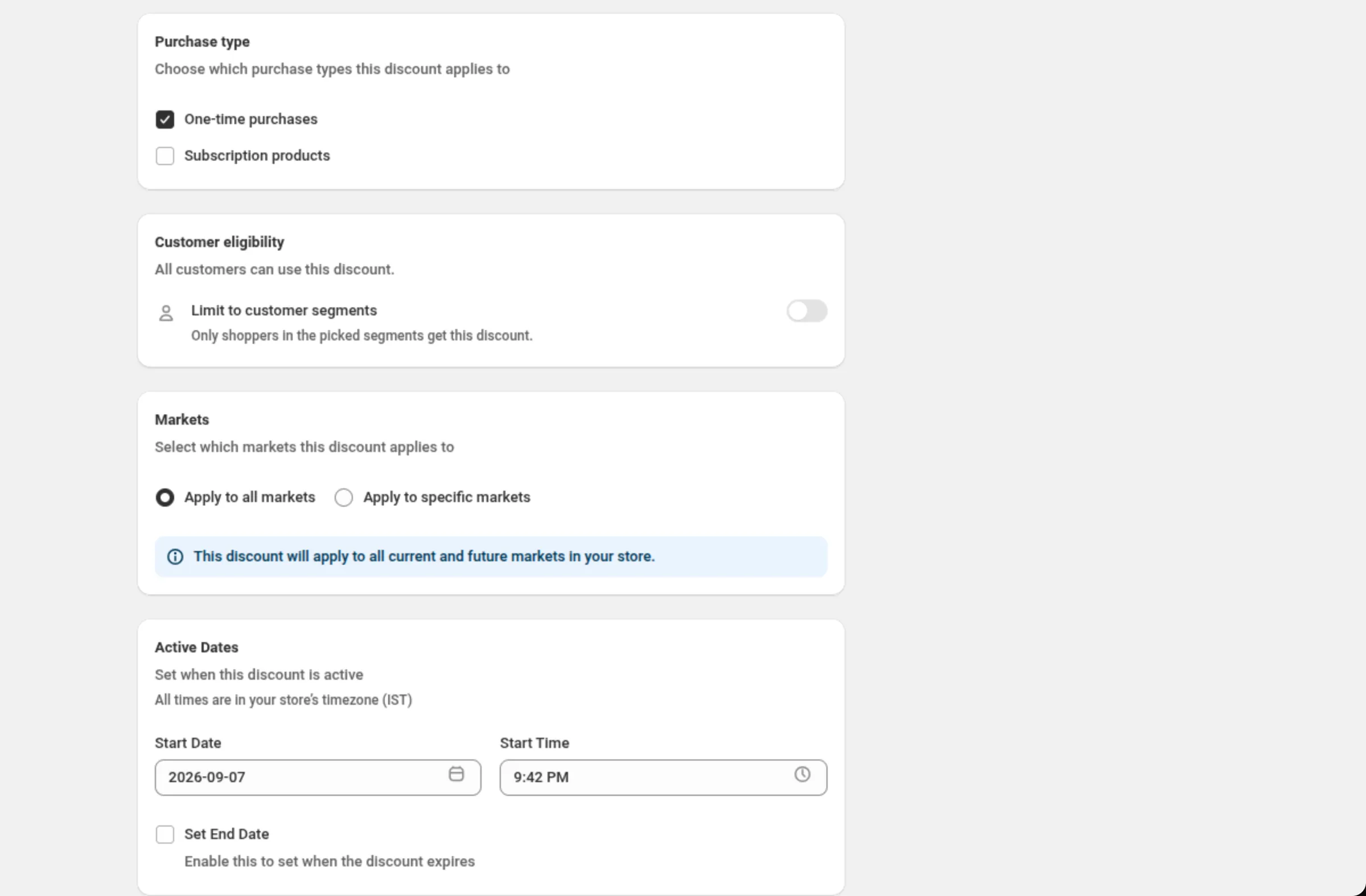
Purchase type
Section titled “Purchase type”One-time purchases, Subscription products, or both — at least one is required. Ticking subscriptions adds a choice of First payment only, Limited number of payments (up to 100) or All recurring payments.
Customer eligibility
Section titled “Customer eligibility”Limit to customer segments restricts the discount to shoppers in the segments you pick, and Shopify checks the shopper’s segments before the discount applies, in the cart as well. Up to 5 segments on an automatic discount and up to 20 on a discount code.
Markets
Section titled “Markets”Apply to all markets covers every current and future market. Apply to specific markets lets you pick up to 20; at least one is required once you switch to it.
Active Dates
Section titled “Active Dates”Start Date and Start Time say when the discount begins, and Set End Date adds an end. All times are in your store’s timezone, which the card names on screen.
Convert to customer’s currency
Section titled “Convert to customer’s currency”Sits under the Summary. On, the amounts you type are changed into the currency the customer pays in, so 10 off is worth 10 to them; off, your number is used as typed in every currency. It also moves your money conditions, such as a cart subtotal rule. Percentages and item counts never change either way, and on a single-currency store the setting makes no difference. Whether it can still be changed after the discount exists depends on the discount — the card either shows the switch or states the value with “Can’t be changed after the discount is created.”
Examples
Section titled “Examples”10% off every order, capped at 50
Discount method: AutomaticTitle: Summer sale · 10% offDiscount Type: Percentage offPercentage: 10Set maximum discount amount: tickedMaximum Discount Amount: 5010 off orders over 50, as a code
Discount method: Discount CodeDiscount Code: SAVE10Discount Rules → RULE GROUP #1 → Cart subtotal · is greater than or equal to · 50Discount Type: Fixed amount offDiscount Amount: 10Limit to one use per customer: ticked15% off the order, but never on the gift-wrap collection
Discount method: AutomaticTitle: Autumn 15% offDiscount Type: Percentage offPercentage: 15Don't apply this discount to specific items: tickedSelect collections to exclude: Gift wrapMinimum requirements (discount rules): Count excluded items toward requirements5% off, only if the order is still worth 100 after product discounts
Discount method: AutomaticTitle: Loyalty 5% offDiscount Type: Percentage offPercentage: 5Require a minimum order amount after product discounts: tickedMinimum amount: 100How it shows to the shopper
Section titled “How it shows to the shopper”An automatic order discount needs nothing from the shopper: Shopify applies it as soon as the order matches, and the Title you typed is the name shown next to the saving. A code discount applies once the shopper enters the code you set.
If Convert to customer’s currency is on, a shopper paying in another currency sees the converted saving next to that same title — so a title like “€10 off” reads oddly for them, while a name like “Summer sale” does not.
Limits and notes
Section titled “Limits and notes”- Percentage: greater than 0, at most 100.
- Excluded items: up to 20 products and up to 10 collections.
- Exact per-currency amounts: up to 20 currencies, and only on a discount that converts currency.
- Customer segments: up to 5 on an automatic discount, up to 20 on a discount code.
- Markets: up to 20 when you pick specific markets.
- Subscriptions: up to 100 recurring payments when you choose a limited number.
- Blocked combination: the minimum order amount after product discounts cannot be used with Set maximum discount amount or Set cart value limit for discount calculation.
- Combinations are Shopify’s call. Ticking a box in Discount can be combined with tells Shopify this discount may run alongside that kind; Shopify decides what actually applies to an order. Combining several kinds can add up to a large total, so test a few carts.
- Segments live in Shopify. If a segment is deleted there, Shopify stops enforcing that gate and the discount becomes available to all customers on Shopify’s side. The app shows the missing segment and refuses the save until you remove it or pick another one.
- The method is fixed after creation. Automatic and Discount Code cannot be swapped on an existing discount; duplicate it instead.
What is the difference between a Cart subtotal condition and Minimum order amount (after product discounts)? A Cart subtotal condition checks the amount before discounts. The minimum order amount is checked by Shopify on the total that remains once all product discounts are deducted. You do not need both, and the card says so on screen.
Why can’t I use the minimum order amount together with a maximum discount cap? The app blocks that pair inline and again on save. A capped amount would have to be worked out from the after-discount total, which the discount cannot see while it is being calculated. Turn off either the minimum or the cap.
Can I change an automatic discount into a discount code later? No. The method is chosen at creation and the chooser is disabled on the edit page. Use Duplicate and pick the other method on the copy.
How many products and collections can I exclude? Up to 20 products and up to 10 collections on one order discount.
Related
Section titled “Related”- Product discount — take money off qualifying items rather than the order total.
- Shipping discount — take money off the delivery cost.
- Create your first discount — the same flow, walked end to end.